Hey all,
For those of you who are still following the development of this blog probably think Trevor and I are no longer talking to each other since I've been m.i.a. for the last few months of posts...not to worry. We're back in Calgary trying to readjust to Canadian life and support the project from here while the work continues in Ascension without us.
So although we're not actually in Bolivia, we're hoping to keep this blog going with project updates and other random thoughts for anyone who's interested...
Lately we've had a chance to open up a bank account for the organization and are researching the best option of trying to become a registered charity (to be able to give out tax reciepts to donors)...if you don't care about tax reciepts and want to donate, we'd love to hear from you!
We've also been doing some voluteer work with CAWST. A few weeks back they had an open house and we were interviewed for an online news site....frankly I think we look like fools in the video, but I think it might provide some insight into the work we were doing in Bolivia, CAWST's role, the filters...etc.: http://www.quantumshift.tv/v/1182903414/
take care all!
Wednesday, July 04, 2007

Saturday, June 23, 2007
The EXTREMELY holy trinity

In late April we took a welcome break from the frustrations of trying to coordinate with the town authorities to do a little bit of travelling. We were to use the may day long weekend to take a long-awaited trip to the city of Trinidad (whose full name is La Santisma Trinidad, which literally means the very holy trinity).
We were a little nervous about the voyage, having heard that trinidad isn't the most pleasant part of Bolivia, especially given its reputation for open sewers on the sides of its streets. It also almost 300 km north of Ascension, making it quite close to the equator, rather deep in the amazon basin , and giving it a very humid, muggy climate. On the other hand we were excited at the chance to see another part of the country, and to visit Fanny (the mother-in-law of a local pastor who had befriended Janaki and I).
As it turned out, the city was quite pleasant and laid back, the open sewers (just storm sewers, thankfully) didn't smell too bad, and the weather was refreshingly cool. We had a great time with Fanny and she gave us a tour of some of the interesting sites around the city. One of the highlights was seeing the Rio Mamore, one of the major tributaries of the amazon. It was 800 m wide, and in it we saw a river dolphin.
The river was higher than usual, thanks to some serious flooding that occurred in the region earlier this year. As a result of the flooding many people lost their homes, and the road between Trinidad and the rio mamore was lined with refugee camps of people whose homes were still under-water even though the rains that had caused the flooding had stopped a couple of months before.
At times it felt like our trip was one disaster after another, or at least one very stressful situation after another. The weekend in Trinidad was no exception. In this case it was me getting a throat infection. It started as a sore throat, then quickly became a spiking fever. We ended up going the the Trinidad hospital at about 1am because we didn't know what was causing me to have such a high fever... luckily I was feeling better within a couple of days with the help of some antibiotics. In spite of the unplanned visit to another bolivian hospital, the trip to trinidad was a refreshing rest from the pressures of the project.
Photo: Some folks near Trinidad Paddling across what was formally a farmer's field. Note flooded home in background.
Sunday, June 10, 2007
Expanding the project

After our initial rush of the first 9 installations, our priority became expanding the project to include the rest of the Ascension de Guarayos in the most efficient way possible.
We faced 2 major challenges in reaching the rest of the town:
1) Prioritizing which members of the community needed the filters the most - The town has about 2400 families without running water. All of them are at risk to an extent, but some have relatively well-protected wells (more secure, while still under the threat of contamination), while others are drinking water from shallow springs, or streams running through the middle of town (probably much more contaminated).
2) Coordinating a work schedule with the members of the community - With the original pilot project with the old organization, we worked under the philosophy that people needed to contribute their labour to receive a filter, in the hopes that they would value it more, and therefore take better care of it. This wasn't too complicated in the church community where we worked, because there were only 30 families and they all knew our employees. Working with the entire town is, however, another story.
Ascension is divided into 16 neighbourhoods, each with a president in charge of representing its people. We decided that while we got the organization better organized and searched for dependable funding, we should try to install 20 filters in each neighbourhood as a sort of large pilot project. The neighbourhood presidents appeared to be the key to both prioritizing the 20 families with the most urgent need (since they should know the people of their neighbourhood, and therefore, which families need the filters first) and coordinating with the people (since they should know where the citizens of the neighbourhood live and be able to get them to come to meetings).
We decided to have a meeting with the neighbourhood presidents to discuss our strategy for reaching the most needy of Ascension and ask if they'd be willing to help us. Unfortunately, the results of the meeting were not what he had hoped for... a total lack of participation... and no questions. We called a second meeting to discuss a strategy with the presidents of the 6 poorest neighbourhoods of the town, but this time, no one even showed up. Finally we managed to meet with 3 of the neighbourhood presidents. They agreed to cooperate, making these the first three neighbourhoods in which we would work.
As I write this, the Bolivian employees have begun in the to work in the 2nd neighbourhood.
Our experience taught us that we cannot rely soley on neighbourhood presidents... our search for an improved work-plan in the neighbourhoods is ongoing, but we have made progress in the area.
Photo: Trevor with 2 of our Bolivian team members (Ángel and Roberto), waiting outside the El Comité de Vigilancia to have what turned out to be a very unproductive meeting with local authorities.
Wednesday, June 06, 2007
Back home
Janaki and I arrived safely in Calgary on May 28th.
The project continues marching on without us... there are now 27 installed filters.
The last month in Bolivia was quite a whirlwind. We actually had far more to write about in the past month than we had in most other months on the trip, but couldn't do so because we were far too busy and, at times, exhausted. However, now that we're back, there should be some posts upcoming... also, when I find the energy I am planning to add a ton of pictures.
Even though we are back in Canada, the work of our organization is set to continue, so we'll probably continue posting project updates once in a while.
chau
The project continues marching on without us... there are now 27 installed filters.
The last month in Bolivia was quite a whirlwind. We actually had far more to write about in the past month than we had in most other months on the trip, but couldn't do so because we were far too busy and, at times, exhausted. However, now that we're back, there should be some posts upcoming... also, when I find the energy I am planning to add a ton of pictures.
Even though we are back in Canada, the work of our organization is set to continue, so we'll probably continue posting project updates once in a while.
chau
Tuesday, May 15, 2007
Installations

In the second week of April, after months of preparation and frustration, we finally, finally reached the point where we were ready to install filters. Next came the awkward task of going to the 9 families who had worked with us back in November and December (and thus had technically earned their filter long ago, since our philosophy is that people have to help to make their filter to get one, so that they have more appreciation for it) and trying to explain what had gone wrong.
Luckily, for the most part, they were quite understanding... most of them even volunteered to help us wash the gravel and sand for their filters. A few were a bit frustrated with us, but that is to be expected, I suppose.
We decided to get the 9 installations done as soon as possible, because we were running short on time in this trip, and wanted to expand the project to the entire town before we left the country(as opposed to the church community were we originally started working).
We ended up doing 9 installations in 4 days, which was crazy considering we had never done one before. It was a bit of a mistake, as we ended up needing to rush to keep up to the schedule, and we all ended the week quite exhausted from working 11 hour days...
In the end we got it all done with relatively few problems, while learning a great deal about how to create a reasonable work schedule so that we do not end up rushing the installations and burning us out. Something that will serve the organization well as we try to expand the original project.
We recently completed follow-up visits to the original 9 families, and much to our satisfaction, they are using their filters without any problems, and seem very receptive to the hygiene training that our employees give them.
It finally seems that our work down here is starting to show results.
Photo: Fermina - the proud owner of the first filter that we installed in Bolivia. Only 6.75 months after we arrived in the country! Her family 'only' had to wait another 5 months after they had been told they'd receive the filter by our previous boss.
Saturday, May 05, 2007
A bit of an update

Sorry for the lack of updates for the past 10 weeks or so...
The last 2 months and a bit have been extremely busy, and at times tense... Busy because we´ve just kept on working on the project, and tense thanks to the rather unfortunate and unpleasant dispute that we continue to have with the directors of our former NGO.
Here is basically what we´ve been up to...
New work site - after working in front of a local pastor´s house for nearly 4 months, it became apparent that we were no longer welcome (a new NGO was coming to town and they were going to occupy our space). After about a week of trying to find a suitable worksite to rent, finally got one for free, thanks to a sweet deal with the mayor´s office that came with free transportation for our filters (we have to install the maximum number possible while properly educating the users... sounds like a plan).
CAWST course refresher - In late March, Diana Frost, a CAWST international advisor, came to Camiri, Bolivia (a fairly large town in the south of the department of Santa Cruz) to teach some local NGO´s about the biosand filter. We decided to take advantage of the opportunity to send our (then) employees to the course to make sure that what we were teaching them was correct. Janaki and I also ended up joining the course for the last couple days, and although we couldn´t get away for long enough to really explore the area, it was a nice change in scenery from our regular Ascensión-Santa Cruz stomping ground. We found the course useful, but discouraging at the same time, because it seems that CAWST knows about as much about issues that one may encounter with the new flow rate as we do...
New molds - One thing we learned at the CAWST course, was that the stupid molds that were giving us so much trouble when we worked with the old organization were worse than we had thought... after looking at them Diana informed us that they did not have the correct measurements and that the walls on the filters that they produced were way too thin... part of the reasons our filters always broke...
Even before we knew this we had already started making new ones... a very long process that started with buying large planks of sheet metal in Santa Cruz in early march, transporting them to Ascensión in buses (a story in and of itself) and spending lots of time with welders as they worked with them.... as I write this, they are just finishing up... making it more than 2 months to get 3 molds made...
On the bright side: The two molds we have so far are fantastic! Of 19 filter boxes we have poured 19 filters have worked.... it has been a little less frustrating than our 45% success rate with the other molds.
New employees - After three months of working with us, and going to Camiri to become an expert, Mariano, left the organization to become an illegal motorcycle-taxi driver. I suppose to earn more money...
So... we moved on and hired 2 new employees, both of whom bring a lot of construction experience and enthusiasm to learn. One of whom has lived here his whole life and has worked with other NGOs in the area and thus brings a lot of useful ideas and local knowledge.
Within two weeks of working with these guys, we had solved the flow rate problem (thanks to some good fine sand and a lot of work), and with good, sturdy filter boxes (thanks to 2 new molds).... we were ready to install filters in the homes of Ascensión de Guarayos.
And as I write this we have 14 filters installed (more details to come)....
Photo: The course in Camiri. The woman in the blue shirt by the filter in the middle is Diana Frost, who led the course, and is now one of the BCC Water Network's board members (January, 2008).
Wednesday, February 28, 2007
Out of the frying pan and into the fire
Due to some differences of opinion with respect to how funds were spent in the organization, we´re no longer going to be volunteering with CEAGUAC.
The last message sent to us by the founders of the organization was not exactly amicable, so for obvious reasons we´re going to keep details to a minimal.
We do, however, still maintain our commitment to helping the people in Ascensión who lack access to potable water.
We´ll keep you posted on our progress.
The last message sent to us by the founders of the organization was not exactly amicable, so for obvious reasons we´re going to keep details to a minimal.
We do, however, still maintain our commitment to helping the people in Ascensión who lack access to potable water.
We´ll keep you posted on our progress.
Monday, February 26, 2007
Remembering Chris
I would like to take a moment to reflect on the life of a good friend of mine who passed away three years ago today.
The way in which he made the best of his situation in spite of his many health problems has and will continue to inspire me to overcome any obstacles that I may face (Including but certainly not limited to the ones that we´ve faced here).
Thanks Chris
The way in which he made the best of his situation in spite of his many health problems has and will continue to inspire me to overcome any obstacles that I may face (Including but certainly not limited to the ones that we´ve faced here).
Thanks Chris
Friday, February 16, 2007
A little political background
As we´ve mentioned a few times in this blog, politics is a very important part of daily life in Bolivia. There always seems to be something big happening in the country in support of/ or opposition to the government whether it is blockaded roads, stores shut down in protest, riots (usually on the other side of the country, thankfully), political marches, or hunger strikers in the central plaza. The factors contributing to these actions are generally very complex, but since they have affected us on a few occaisions on this trip, and are so important to understanding Bolivia generally, I am going to do my best to give them a brief explanation.
Many of the current political issues facing Bolivia have their roots in the complex ethnic make-up of the country. Although it was conquered by the Spanish in the early 1500s, they did not succeed in eradicating/assimilating the native population to the extent that they had in many other of their colonies. For this reason, over 60% of Bolivia´s population is of pure indigenous descent, and more than 40% of the population speaks an indigenous language rather than Spanish.
At the times of the Spanish conquest, the rugged Bolivian highlands were a part of the Incan empire and were occupied by the Quechua-speaking Incas, and their predecessors, the Aymara. Both of these groups had sedentary lifestyles and complex civilizations. The lush, tropical lowlands, were occupied by a diverse mixture of hunting/gathering tribes. Although many indigenous people live in the major cities of Bolivia, there are still millions who live in isolated areas and practise a more or less traditional way of life.
When the spanish arrived, they enslaved natives to extract silver from the highlands, and work on agricultural plantations in the lowlands. As is the case in most of Latin America (and according to some North America as well), indigenous people have generally been treated as second-class citizens ever since, with less access to education, clean water, health care, etc. than their counterparts of European or mixed descent.
Finally after almost 500 years of being ruled by viceroys, generals, and presidents of European descent, Bolivians elected an indigenous leader (with well over 50% of the popular vote in a multi-party democratic election), promising to correct age-old injustices, and provide Bolivia´s marganilized citizens a better way of life. Obviously the wealthy elite of the country, especially in the eastern areas where we are currently residing, are quite untrusting of these initiatives.
Many of the current political issues facing Bolivia have their roots in the complex ethnic make-up of the country. Although it was conquered by the Spanish in the early 1500s, they did not succeed in eradicating/assimilating the native population to the extent that they had in many other of their colonies. For this reason, over 60% of Bolivia´s population is of pure indigenous descent, and more than 40% of the population speaks an indigenous language rather than Spanish.
At the times of the Spanish conquest, the rugged Bolivian highlands were a part of the Incan empire and were occupied by the Quechua-speaking Incas, and their predecessors, the Aymara. Both of these groups had sedentary lifestyles and complex civilizations. The lush, tropical lowlands, were occupied by a diverse mixture of hunting/gathering tribes. Although many indigenous people live in the major cities of Bolivia, there are still millions who live in isolated areas and practise a more or less traditional way of life.
When the spanish arrived, they enslaved natives to extract silver from the highlands, and work on agricultural plantations in the lowlands. As is the case in most of Latin America (and according to some North America as well), indigenous people have generally been treated as second-class citizens ever since, with less access to education, clean water, health care, etc. than their counterparts of European or mixed descent.
Finally after almost 500 years of being ruled by viceroys, generals, and presidents of European descent, Bolivians elected an indigenous leader (with well over 50% of the popular vote in a multi-party democratic election), promising to correct age-old injustices, and provide Bolivia´s marganilized citizens a better way of life. Obviously the wealthy elite of the country, especially in the eastern areas where we are currently residing, are quite untrusting of these initiatives.
Sunday, February 11, 2007
The project: frustrations, barriers and lessons learned
I would be lying if I said that this trip to Bolivia has been all fun and games. Our frustration with our experiences here peaked in the past month, when I picked up a parasitic infection on a trip back to Santa Cruz from our project site to battle through another chapter of sorting out our immigration situation (which needless to say, continued to be a bureaucratic nightmare). I recovered from it fine, after an educational visit to a private Bolivian hospital (my illness wasn´t really that bad, but we didn´t know any doctors and the hospital is conveniently located a short walk from our beloved Hotel Aeronáutico) and Janaki and I restarted work again later in the week (our new employees diligently continued in Ascensión without us, they´re good kids).
Our frustrations resurfaced a couple of weeks later when someone snuck into our room in Ascensión and stole the majority of the money that we had with us to pay for project supplies and the wages of our employees (we are getting reimbursed). This was especially inconvenient because we have no way of accessing our bank accounts in Ascensión. We ended up being fine, however, and work with the project has continued as normal.
Which brings us to the project...
Back in October, when we were still building practice filters in Santa Cruz, we thought that the pilot project would be just the beginning.... get it done in a month or two, write up a report for funding organizations about how great everything went, and wait for the real funds to start coming into CEAGUAC to cover future projects... right...
Now, more than 4 months into our trip, and more than 3 months after we first disembarked from the now all-too-familiar 5.5 hour ride on the Trans-Guarayos bus from Santa Cruz to Ascensión, we still haven´t installed the first of our 30 filters.
How can this be?
Well... we have faced, and continue to face 2 major obstacles to installing a filter in someone´s house.
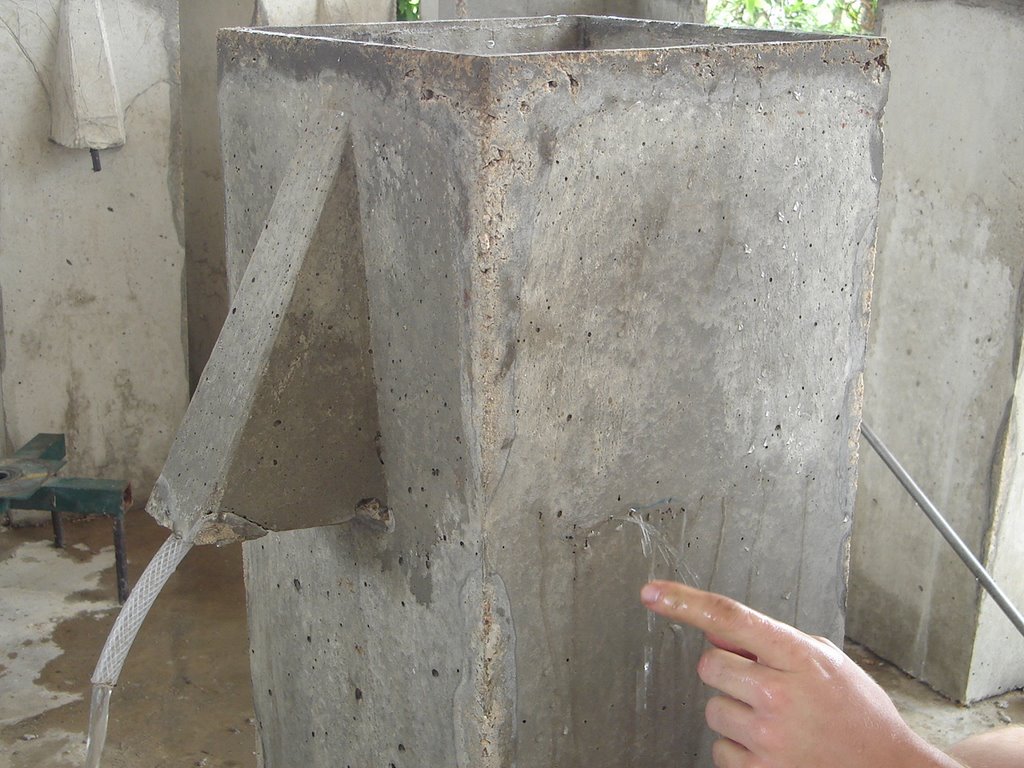
Making filter boxes - we were so excited in Santa Cruz, when we first build a working filter box, but the problems that caused the first ones to break have continued to haunt us. Of the 34 filter boxes we have poured in Bolivia so far, an unimpressive 14 have been successfully demolded without breaking. The problems, we have learned, come from the molds themselves. The concrete gets stuck in grooves and minor-looking imperfections in the molds, causing the filter boxes to break as we try to take the molds off the filters. We have done our best to fix this problem - taking the molds to 3 different welders in Ascensión, and more recently, using metal sand paper and a grinder to try to smooth out the bumps, and now epoxy to try to fill in some of the troublesome grooves. We´ll try to make some more on Monday to test our latest attempt, but so far, our efforts have only brought sporadic success.
Getting the proper flow rate - For the filters to work water needs to flow through them at about 1 L per 60 seconds. If it´s much faster, the filters won´t properly treat the water, and if it´s much slower the users might become impatient and not want to use their filter. To get the right flow rate, the employees and us have spent countless hours preparing media and installing practice filters at our work site. Finally, on about our 12th attempt we reached that illusive flow rate of 1 L per minute...Wonderful! Except that we recently found out that CAWST is now recommending a flow rate of a 1L per 100 seconds to ensure that the filters work at optimal efficiency. This has lead us to have to go hunting around Ascensión for the right sand for the job... a process that is ongoing.
Add to these problems the fact that the beginning of the project was delayed for a month for various reasons (see October and early November blog entries), we lost half of our potential workdays in November to getting a run-around from immigration and the Santa Cruz branch of INTERPOL, and we were rendered inefficient in December by a labour dispute with the organization´s sole paid employee at the time (who is now preparing to start working in Switzerland).... and you start to see why we are in the position that we are in.
But... there is a bright side... our new employees, citizens of Ascensión, are continuing to show a great deal of promise and enthusiasm. We´ve finished training them, so they now know everything we do about household water treatment and the biosand filter, and the general principles of hygiene and sanitation on top of their extensive knowledge of local customs, hygiene practices, sanitation issues, and the health problems that face community members.
We now have 4 minds working through our above-mentioned 2 major problems, instead of just 2, as was the case in December.
From here the goal is to get those filters installed, sometime before we go back to Canada in May, and leave them with the know-how and resources necessary to continue working in other communities in eastern Bolivia, and teach others what they have learned.
Wow! long entry, hey? I hope that makes up for the fact that I haven´t been heard from since November.
Our frustrations resurfaced a couple of weeks later when someone snuck into our room in Ascensión and stole the majority of the money that we had with us to pay for project supplies and the wages of our employees (we are getting reimbursed). This was especially inconvenient because we have no way of accessing our bank accounts in Ascensión. We ended up being fine, however, and work with the project has continued as normal.
Which brings us to the project...
Back in October, when we were still building practice filters in Santa Cruz, we thought that the pilot project would be just the beginning.... get it done in a month or two, write up a report for funding organizations about how great everything went, and wait for the real funds to start coming into CEAGUAC to cover future projects... right...
Now, more than 4 months into our trip, and more than 3 months after we first disembarked from the now all-too-familiar 5.5 hour ride on the Trans-Guarayos bus from Santa Cruz to Ascensión, we still haven´t installed the first of our 30 filters.
How can this be?
Well... we have faced, and continue to face 2 major obstacles to installing a filter in someone´s house.
Making filter boxes - we were so excited in Santa Cruz, when we first build a working filter box, but the problems that caused the first ones to break have continued to haunt us. Of the 34 filter boxes we have poured in Bolivia so far, an unimpressive 14 have been successfully demolded without breaking. The problems, we have learned, come from the molds themselves. The concrete gets stuck in grooves and minor-looking imperfections in the molds, causing the filter boxes to break as we try to take the molds off the filters. We have done our best to fix this problem - taking the molds to 3 different welders in Ascensión, and more recently, using metal sand paper and a grinder to try to smooth out the bumps, and now epoxy to try to fill in some of the troublesome grooves. We´ll try to make some more on Monday to test our latest attempt, but so far, our efforts have only brought sporadic success.
Getting the proper flow rate - For the filters to work water needs to flow through them at about 1 L per 60 seconds. If it´s much faster, the filters won´t properly treat the water, and if it´s much slower the users might become impatient and not want to use their filter. To get the right flow rate, the employees and us have spent countless hours preparing media and installing practice filters at our work site. Finally, on about our 12th attempt we reached that illusive flow rate of 1 L per minute...Wonderful! Except that we recently found out that CAWST is now recommending a flow rate of a 1L per 100 seconds to ensure that the filters work at optimal efficiency. This has lead us to have to go hunting around Ascensión for the right sand for the job... a process that is ongoing.
Add to these problems the fact that the beginning of the project was delayed for a month for various reasons (see October and early November blog entries), we lost half of our potential workdays in November to getting a run-around from immigration and the Santa Cruz branch of INTERPOL, and we were rendered inefficient in December by a labour dispute with the organization´s sole paid employee at the time (who is now preparing to start working in Switzerland).... and you start to see why we are in the position that we are in.
But... there is a bright side... our new employees, citizens of Ascensión, are continuing to show a great deal of promise and enthusiasm. We´ve finished training them, so they now know everything we do about household water treatment and the biosand filter, and the general principles of hygiene and sanitation on top of their extensive knowledge of local customs, hygiene practices, sanitation issues, and the health problems that face community members.
We now have 4 minds working through our above-mentioned 2 major problems, instead of just 2, as was the case in December.
From here the goal is to get those filters installed, sometime before we go back to Canada in May, and leave them with the know-how and resources necessary to continue working in other communities in eastern Bolivia, and teach others what they have learned.
Wow! long entry, hey? I hope that makes up for the fact that I haven´t been heard from since November.
Friday, January 12, 2007
Once Upon a Time in the Project
This here water project has been the cause of many frustrations, panic-stricken nights and at times sadness at the slow progress we’ve made over the last few months. While there were many contributing factors, one in particular was our concern that the work we’d been doing to set up the organization was not going to realistically continue given that we were only really working with one other person here.
Before Christmas this changed when serious disagreements with our one employee led to him no longer continuing with the organization. We spent some of our time in Samaipata developing a new project plan for the next few weeks and interview questions to hire a couple people in the community. All the prep work was worth it because this past week we successfully hired two people to fill the roles of a Filter Technician and a Community Steward.
So far they haven’t let us down. We’ve been so impressed by their excitement for the project and truly enjoy hearing the suggestions they offer us in attacking some of the project’s major problems. There is also some sign that at least one of them will want to continue with the organization in the future and they both seem open to training any new staff that the organization may need to hire.
While there are certainly still many obstacles ahead, we feel like we’re more on track now than we’ve ever been.

Tuesday, January 09, 2007
In Search of El Fuerte

Sorry for the lack of blog posts for the last little while. Hope everyone had a great Christmas and that the New Year is treating them well so far.
We headed back to Santa Cruz for Christmas Day and soon after escaped to Samaipata, a sleepy tourist town about 2 hours SW of Santa Cruz. The town itself is pretty unique since it is where Bolivia’s lowlands meet its highlands. This makes for some pretty spectacular landscape. Our appreciation for the Andean ranges started with our drive down there. Our shared taxi driver zipped through the mountains with ease despite his excessive speed and distractions like roaming donkeys, dogs, rock debris and newly established creeks flowing across the road along the way.
A big part of Samaipata’s draw for tourists is El Fuerte, a Pre-Columbian archeological site. It’s been declared a UNESCO World Heritage Site in particular because of the significant work preserved on a large surface of rock a top of a mountain peak. We were certain that we had to check it out, but thought it would be cool to go on an alternative route to the site that we’d heard about on New Year’s Eve.
Long story short we got lost. And although we managed to see some spectacular views, when we realized that what we presumed to be El Fuerte was still two valleys and a significant peak away, hiking back to Samaipata before a) we ran out of water and b) the sun went down, became our new priority,
Ín the end we ended up having to cut through privately owned forested area to get to what we thought was the main road to Samaipata. Instead, it was a scenic view (not what we were hoping for at this time) to a ridge overlooking the town. From there we hiked down to the bottom of a valley which once again was supposed to lead us to the main highway. One last ridge climbed and we were on our way back just in time for sunset.
So 12 after hours of hiking through more than 30km of rough terrain we arrived in Samaipata, downed water and juice and tried to relax while children lit firecracker after firecracker outside. Overall, it made for a pretty incredible, but strange New Year’s.
We did make it out to El Fuerte a couple of days later. While it was certainly an interesting place, it’s safe to say that it would have had to be pretty darn marvelous to live up to the expectations we had created for it during our long journey to find it.
Photo: a back country valley in the Andean foothills, taken during our search for El Fuerte. Lots of nice scenery, but no tour of pre-columbian ruins that day.
Wednesday, November 29, 2006
Things are getting serious... Or so they say
The political situation in our autonomist little corner of Bolivia is getting interesting to say the least. El Presidente de la Republica, (indigenous) Evo Morales, has successfully managed to tweek the law-making process to make it a little easier for his party (Movimiento A Socialismo or MAS) to enact land reforms. This is a touchy issue throughout Latin America, where, generally, a few hundred (mainly white) rich famillies own vast tracts of land while poor peasants are left with next to nothing. Evo has taken it upon himself to try to rectify 500 years of such injustice by redistributing some of the land currently owned by these few families to (mainly indigenous) peasants.
This is making the rich and powerful, who seem to be concentrated in Santa Cruz and neighbouring Tarija, quite outraged. There are people hunger striking in the principal Plaza of Santa Cruz, Tarija is threatening to cut of gas supplies to the rest of the country, and there is talk of a national strike that could bring parts of the country to a halt in the next couple of days. We got a letter from the Canadian consulate warning us to stay away from any protests and are feeling a little bit uneasy about the situation overall.
To make matters worse, most of the ´news´ channels in Santa Cruz help fuel the anti-evo sentiment by providing a very one-sided and rediculously over-dramatic portrayal of the issues (complete with scary music and weird camera angles to emphasize the effect).
The only real alternatives are CNN Español, which has some US-bias, but at least attempts to appear unbiased, and Evo Morales´ good friend Hugo Chavez´s very own Telesur, which runs a nauseatingly redundant series of adds supporting Evo and attacking his opponents in every commercial break.
With this sort of media coverage it is no surprise that the country, or at least this part of it, is becoming very polarized. What will come of the situation remains to be seen.
This is making the rich and powerful, who seem to be concentrated in Santa Cruz and neighbouring Tarija, quite outraged. There are people hunger striking in the principal Plaza of Santa Cruz, Tarija is threatening to cut of gas supplies to the rest of the country, and there is talk of a national strike that could bring parts of the country to a halt in the next couple of days. We got a letter from the Canadian consulate warning us to stay away from any protests and are feeling a little bit uneasy about the situation overall.
To make matters worse, most of the ´news´ channels in Santa Cruz help fuel the anti-evo sentiment by providing a very one-sided and rediculously over-dramatic portrayal of the issues (complete with scary music and weird camera angles to emphasize the effect).
The only real alternatives are CNN Español, which has some US-bias, but at least attempts to appear unbiased, and Evo Morales´ good friend Hugo Chavez´s very own Telesur, which runs a nauseatingly redundant series of adds supporting Evo and attacking his opponents in every commercial break.
With this sort of media coverage it is no surprise that the country, or at least this part of it, is becoming very polarized. What will come of the situation remains to be seen.
Saturday, November 18, 2006
Back in the Santa Cruz Groove
After a little over a week of working on the project in Guarayos, we´re back in our home away for home for a few days. We were hoping to have our visa situation taken care of while here, but that was a bust, so we´ll likely have to make a trip back next week before our current visas expire.
Overall it´s been very strange being back. There were certainly times when we were in the town where we felt incredibly far from our routines in the big city. Ascensión is a quaint town where motorbikes dominate the streets (which are mostly unpaved), chickens and dogs are numerous and roam freely, and the bugs are big and plentifuly. We are staying with a local gentleman in a house in the neighbourhood on the outskirts of the town where our project is taking place. Overall, we´ve adjusted quite well to small town life, and the fact that we haven´t been staying in our cozy Santa Cruz hotel anymore. We´ll try to get some pictures eventually to show you what the town is like.
The project has not progressed without problems, but the townsfolk have been really helpful and patient with us. We also have been working successfully with a local pastor to educate the people who will be receiving filters and we are confident that things will work out... we´ll just be there a lot longer than we had originally expected.
Overall it´s been very strange being back. There were certainly times when we were in the town where we felt incredibly far from our routines in the big city. Ascensión is a quaint town where motorbikes dominate the streets (which are mostly unpaved), chickens and dogs are numerous and roam freely, and the bugs are big and plentifuly. We are staying with a local gentleman in a house in the neighbourhood on the outskirts of the town where our project is taking place. Overall, we´ve adjusted quite well to small town life, and the fact that we haven´t been staying in our cozy Santa Cruz hotel anymore. We´ll try to get some pictures eventually to show you what the town is like.
The project has not progressed without problems, but the townsfolk have been really helpful and patient with us. We also have been working successfully with a local pastor to educate the people who will be receiving filters and we are confident that things will work out... we´ll just be there a lot longer than we had originally expected.
Tuesday, November 07, 2006
Chau Santa Cruz. Hola Ascension!
So it seems after some delay we will be leaving for Ascension de Guarayos this afternoon to begin the pilot BioSand Filter project.
If we have internet access we´ll definitely keep you posted, if not, then we´ll be back in Santa Cruz in a couple of weeks to update y'all.
Take care and hasta luego!
If we have internet access we´ll definitely keep you posted, if not, then we´ll be back in Santa Cruz in a couple of weeks to update y'all.
Take care and hasta luego!
Saturday, November 04, 2006
Pictures!
So we´ve finally have some pictures up on the web. We´ll do our best to update them when we are able.
You can find them at: http://boliviapics.shutterfly.com
You can find them at: http://boliviapics.shutterfly.com
Just hangin´ out...
 Well, not much is new to report lately. Janaki and I remain in Santa Cruz waiting for things to get organized so that we can head out to Ascensión de Guarayos to begin the pilot project. We have been continuing our quest for a visa, and have made some significant progress (100% thanks to Alejandro´s help) but still do not have it. Other than that we have been hanging out in the downtown area loading pictures onto the internet (a very time consuming and frustrating process), practising Spanish, going to movies and a even checking out a yoga class....
We went on a really refreshing stroll today on the outskirts of the city by the River Piraí. The river was absolutely beautiful with a wide sandy floodplain bordered by seemingly untouched forest with a nice view of mountains on the horizon. It is also a popular swimming spot for the locals. We decided to take a walk through some of the settlements on the edge of the city and into the jungle. Unfortunately we have no pictures to show from today, so instead you can enjoy checkin´out this lizard that was chillin´on on the front door of our hotel a couple of days ago.
Tuesday, October 24, 2006
M.I.A.
Sorry for the lack of updates for the past week. A busier schedule and head colds have kept us away from internet cafes. Here´s a bit of a recap of last week:
You´re not in Santa Cruz de la Sierra anymore, Dorothy
Last Thursday we took our first official trip out of the city to some neigbouring villages (about 10 km from the city limits)
Germán, Alejandro and the two of us we hoping to find a site for the pilot water filtering project. The first village we checked out had been recommended by the Rotary Club in Santa Cruz as a potential fit. After chatting (i guess we played more of a listening role..) with the Mayor of the Village it sounded like the people there were already treating their water, so the prospects didn´t seem too good. He did recommend some other places to check out, so that was cool and we were able to provide some material on the filters to a couple of different village representatives.
It was just so interesting to feel a second phase of culture shock coming on...in a lot of ways we´d become really accustomed to our downtown Santa Cruz lifestyle, and seeing life in a village packed with roaming animals, dirt roads and all these uncertainties that we hadn´t been exposed to really shook things up a little.
Evo Sighting...close, but not quite
Later on Thursday we had heard that President Evo Morales was in town signing a big natural gas deal with the Argentinean President meaning that Bolivia will provide Argentina with natural gas for the next 20 years. Evo had been around before, so we didn´t get too excited, except that this time there was a rumour that he was having lunch at a restaurant a block away from our hotel!!
There was tons of media waiting outside the restaurant, and we were right there beside them...especially when we saw them flock around a car. Unfortunately we couldn´t get a close look inside, but it looked like some random woman and not the President at all which was highly disappointing. Oh well, I guess there will be other opportunities...
Getting cultured
Friday we had decided to check out the art scene in Santa Cruz...We were really excited at the prospect of seeing the etnofolklórico museum by Park Arenal, maybe catching a Spanish movie and then taking in a live Bolivian band at a local bar. Our plans ended up a little different when the museum was closed due to need of major (and we are talking major) renovations and our inept palnning skills (okay, this one was my fault) meant we had to head to the massive Calgary-style ¨Cine Centre¨ movie theatre rather than the quaint one down the street from us. We were also slightly disappointed when the movie ended up being in English with Spanish subtitles eventhough it was about the Trujillo dictatorship in the Dominican Republic so everyone has Spanish accents...
The movie itself (called The Feast of the Goat) was both very sad and disturbing, yet showed an interesting perspective on dictatorship overall.
Yvaga Guazu Park
Saturday we ventured to an ecological park in Santa Cruz. There was certainly a healthy dose of skepticism over how a "natural park" within a major city could really be any good, but we were pleasantly surpirised.
The park´s 26 years old and much to Trevor´s excitement had about four hectares of untouched jungle. It also housed a considerable amount of native and non native (but well established) plant species and our tour guide was very thorough in his explanations and we learned a lot eventhough he spoke to us entirely in Spanish.
We witnessed some bats resting in a plant just above our heads (yikes!) and saw a coca plant (i.e. the source of cocaine) up close...not sure it would have been a representative bolivian eco park without one.
Bolivian Road Trip
Sunday would have been an ideal day for a trip to the county except that sitting cramped in the back of a Mitsubishi jeep with a headcold for the 10 hour drive out and back was less than ideal.
Despite this, I could certianly appreciate the lush scenery and the even harsher reality that we were no longer in Santa Cruz de la Sierra any more (please see Trevor´s next blog entry for more details).
When we were actually in Asensión de Guarayos, we were warmly welcomed by a Pastor of the community and his family. The Pastor and his wife seemed genuinely excited about getting involved with the project and even helped us check out sand sources for the filters in the area. So it looks like doing a pilot project here might actually be a fit (fingers crossed).
Immigration...zim boom bah!
This week we´re going to attack the immigration requirements to get our one year visas and we´re going to do it hard. I´m feeling optimistic (which is probably more than a little jaded of me given our recent luck with our dear immigration friends) since Alejandro has offered to help us get the necessary police checks, blood work, notorized legal letters and other doo dads to get the job done. As always, keep you posted.
You´re not in Santa Cruz de la Sierra anymore, Dorothy
Last Thursday we took our first official trip out of the city to some neigbouring villages (about 10 km from the city limits)
Germán, Alejandro and the two of us we hoping to find a site for the pilot water filtering project. The first village we checked out had been recommended by the Rotary Club in Santa Cruz as a potential fit. After chatting (i guess we played more of a listening role..) with the Mayor of the Village it sounded like the people there were already treating their water, so the prospects didn´t seem too good. He did recommend some other places to check out, so that was cool and we were able to provide some material on the filters to a couple of different village representatives.
It was just so interesting to feel a second phase of culture shock coming on...in a lot of ways we´d become really accustomed to our downtown Santa Cruz lifestyle, and seeing life in a village packed with roaming animals, dirt roads and all these uncertainties that we hadn´t been exposed to really shook things up a little.
Evo Sighting...close, but not quite
Later on Thursday we had heard that President Evo Morales was in town signing a big natural gas deal with the Argentinean President meaning that Bolivia will provide Argentina with natural gas for the next 20 years. Evo had been around before, so we didn´t get too excited, except that this time there was a rumour that he was having lunch at a restaurant a block away from our hotel!!
There was tons of media waiting outside the restaurant, and we were right there beside them...especially when we saw them flock around a car. Unfortunately we couldn´t get a close look inside, but it looked like some random woman and not the President at all which was highly disappointing. Oh well, I guess there will be other opportunities...
Getting cultured
Friday we had decided to check out the art scene in Santa Cruz...We were really excited at the prospect of seeing the etnofolklórico museum by Park Arenal, maybe catching a Spanish movie and then taking in a live Bolivian band at a local bar. Our plans ended up a little different when the museum was closed due to need of major (and we are talking major) renovations and our inept palnning skills (okay, this one was my fault) meant we had to head to the massive Calgary-style ¨Cine Centre¨ movie theatre rather than the quaint one down the street from us. We were also slightly disappointed when the movie ended up being in English with Spanish subtitles eventhough it was about the Trujillo dictatorship in the Dominican Republic so everyone has Spanish accents...
The movie itself (called The Feast of the Goat) was both very sad and disturbing, yet showed an interesting perspective on dictatorship overall.
Yvaga Guazu Park
Saturday we ventured to an ecological park in Santa Cruz. There was certainly a healthy dose of skepticism over how a "natural park" within a major city could really be any good, but we were pleasantly surpirised.
The park´s 26 years old and much to Trevor´s excitement had about four hectares of untouched jungle. It also housed a considerable amount of native and non native (but well established) plant species and our tour guide was very thorough in his explanations and we learned a lot eventhough he spoke to us entirely in Spanish.
We witnessed some bats resting in a plant just above our heads (yikes!) and saw a coca plant (i.e. the source of cocaine) up close...not sure it would have been a representative bolivian eco park without one.
Bolivian Road Trip
Sunday would have been an ideal day for a trip to the county except that sitting cramped in the back of a Mitsubishi jeep with a headcold for the 10 hour drive out and back was less than ideal.
Despite this, I could certianly appreciate the lush scenery and the even harsher reality that we were no longer in Santa Cruz de la Sierra any more (please see Trevor´s next blog entry for more details).
When we were actually in Asensión de Guarayos, we were warmly welcomed by a Pastor of the community and his family. The Pastor and his wife seemed genuinely excited about getting involved with the project and even helped us check out sand sources for the filters in the area. So it looks like doing a pilot project here might actually be a fit (fingers crossed).
Immigration...zim boom bah!
This week we´re going to attack the immigration requirements to get our one year visas and we´re going to do it hard. I´m feeling optimistic (which is probably more than a little jaded of me given our recent luck with our dear immigration friends) since Alejandro has offered to help us get the necessary police checks, blood work, notorized legal letters and other doo dads to get the job done. As always, keep you posted.
Agro-business on the Edge of the Amazon
Sunday´s trip to Asensión de Guarayos was our first lengthy excursion out of the fine city of Santa Cruz, and thus offered a second, and more thorough, chance to see the countryside. I was quite excited for this opportunity because Santa Cruz is just south-west of the Amazon basin, which has captured my imagination for as long as I can remember. We left our hotel at 6:30 in the morning and after overloading Germán´s truck with Alejandro, Hernan and our supplies, headed north-east on a surprisingly well-paved 2 lane highway.
Once clear of the city, we were greeted by the lush green countryside - dense tropical forest interspersed with large clearings. Some of the clearings were being grazed by cattle - their clearly visible ribs attesting to the fact that tropical grasses are not incredibly nutritious. The remainder were mostlplanted with soy. At bend in the road I hoped that we would leave the agricultural area, and get to see some relatively undamaged forest. However, after more than an hour it became apparent that I wasn´t seeing dense tropical forest interespersed with large clearings, but rather enormous fields bordered by remaining patches of sparse tropical forest.
The generally nutrient-poor soil of the amazon basin is not great for agriculture. Usually small patches that have been burnt away can support crops for a few rainy seasons before the soil becomes exhausted. It isn´t the ideal location for enormous soy plantations or cattle ranches. Which, I presume, is why Dow Chemicals has such a strong presence in the area. Billboards advertising their wonder pesticides and fertilizers to soy growers were a very common site on both sides of the highway for most of our drive, giving the impression that this type of agriculture is very chemical-dependant.
I expected the owners of huge soy plantations and cattle ranches like these to be very well off. To my surprise, however, the only dwellings visible near the farms were very basic thatched-roof, mud brick huts. They were sturdy looking and well-maintained, but certainly not extravegant. Whether the people who live in them own the large farms (which I find doubtful), work on the large farms, or try to carve out a meager existance by farming small patches of land next to the large farms remains a mystery to me.
To my relief, after about 2 or 2.5 hours driving (including passing through a town with the amusing name of 4 Cañadas) we finally entered hilly landscape of Guarayos. The transition from Saskatchewan-like flatness to rolling hills with impressive granitic rock outrcrops coincided with a disappearance of the large soy farms, and a significant decrease in the number of cattle ranches. At last, we were able to witness some substantial patches of relatively undisturbed jungle. Located in the midst of this beautiful landscape is our pilot project site, Asensión de Guarayos.
Though I expected that the landscape around Santa Cruz would not exactly be prestine, and realized that rainforests are cleared for agriculture all over the world, seeing it in person brought it home a lot harder than reading about it in a textbook or a Lonely Planet guide. I understand that people have to eat, and that Bolivians need jobs, but I can´t help but believe that there must be a better way to provide these essentials than destroying one of the most biologically diverse ecosystems in the world to grow chemical-soaked soybeans. Not to mention the fact that a large portion of the profits go to a US-based megacorporation and that the vast majority of the beans are used to fatten up farm animals in overseas feedlots rather than feed people directly.
ON a more positive note, there are alternative agricultural practises being used in the Amazon basin. For example, yesterday Janaki and I found some chocolate coated Brazil nuts that were made in La Paz from nuts and cocoa beans that had been harvested from wild plants in the Bolivian Amazon basin. No rainforest clearing necessary and another example of delicious locally produced food.
Once clear of the city, we were greeted by the lush green countryside - dense tropical forest interspersed with large clearings. Some of the clearings were being grazed by cattle - their clearly visible ribs attesting to the fact that tropical grasses are not incredibly nutritious. The remainder were mostlplanted with soy. At bend in the road I hoped that we would leave the agricultural area, and get to see some relatively undamaged forest. However, after more than an hour it became apparent that I wasn´t seeing dense tropical forest interespersed with large clearings, but rather enormous fields bordered by remaining patches of sparse tropical forest.
The generally nutrient-poor soil of the amazon basin is not great for agriculture. Usually small patches that have been burnt away can support crops for a few rainy seasons before the soil becomes exhausted. It isn´t the ideal location for enormous soy plantations or cattle ranches. Which, I presume, is why Dow Chemicals has such a strong presence in the area. Billboards advertising their wonder pesticides and fertilizers to soy growers were a very common site on both sides of the highway for most of our drive, giving the impression that this type of agriculture is very chemical-dependant.
I expected the owners of huge soy plantations and cattle ranches like these to be very well off. To my surprise, however, the only dwellings visible near the farms were very basic thatched-roof, mud brick huts. They were sturdy looking and well-maintained, but certainly not extravegant. Whether the people who live in them own the large farms (which I find doubtful), work on the large farms, or try to carve out a meager existance by farming small patches of land next to the large farms remains a mystery to me.
To my relief, after about 2 or 2.5 hours driving (including passing through a town with the amusing name of 4 Cañadas) we finally entered hilly landscape of Guarayos. The transition from Saskatchewan-like flatness to rolling hills with impressive granitic rock outrcrops coincided with a disappearance of the large soy farms, and a significant decrease in the number of cattle ranches. At last, we were able to witness some substantial patches of relatively undisturbed jungle. Located in the midst of this beautiful landscape is our pilot project site, Asensión de Guarayos.
Though I expected that the landscape around Santa Cruz would not exactly be prestine, and realized that rainforests are cleared for agriculture all over the world, seeing it in person brought it home a lot harder than reading about it in a textbook or a Lonely Planet guide. I understand that people have to eat, and that Bolivians need jobs, but I can´t help but believe that there must be a better way to provide these essentials than destroying one of the most biologically diverse ecosystems in the world to grow chemical-soaked soybeans. Not to mention the fact that a large portion of the profits go to a US-based megacorporation and that the vast majority of the beans are used to fatten up farm animals in overseas feedlots rather than feed people directly.
ON a more positive note, there are alternative agricultural practises being used in the Amazon basin. For example, yesterday Janaki and I found some chocolate coated Brazil nuts that were made in La Paz from nuts and cocoa beans that had been harvested from wild plants in the Bolivian Amazon basin. No rainforest clearing necessary and another example of delicious locally produced food.
Subscribe to:
Posts (Atom)